
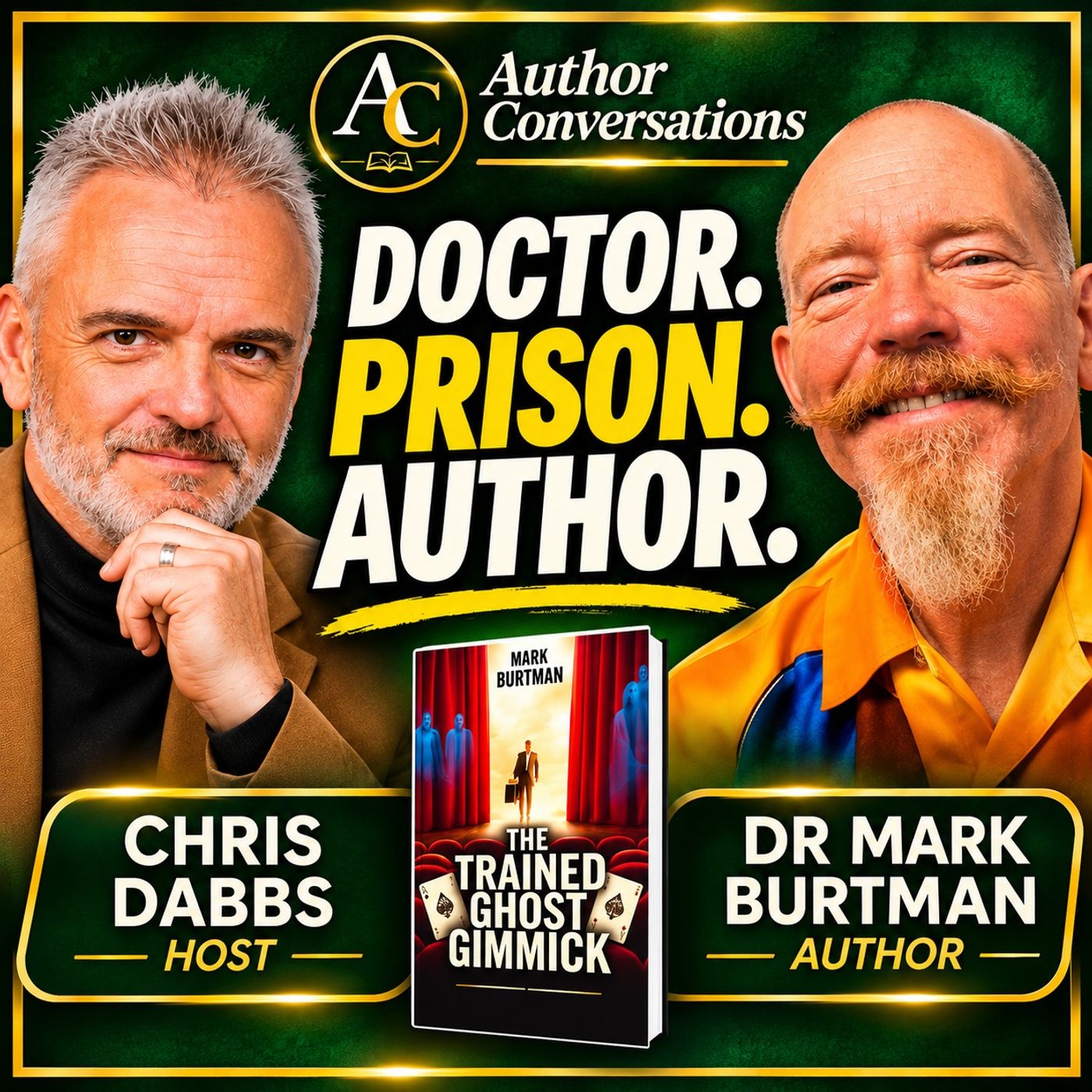
From Doctor to Prison to Author - Dr Mark Burtman's Extraordinary Life

 iHeartRadio

 Apple Podcasts

 Spotify

 Amazon Music

 Deezer

 Podchaser

 Spreaker

 Castbox

 YouTube
Key Takeaways
- Dr. Mark Burtman's extraordinary life journey includes serving as a Navy medical officer and OB-GYN, playing poker at the World Series level, playing bass in a sci-fi/horror-themed band, spending time in prison, and surviving a stroke.
- After losing his medical career and facing significant personal adversity, Dr. Burtman reinvented himself by moving into the automotive industry and ultimately pursuing his long-held dream of writing full-time.
- His supernatural comedy novel, The Trained Ghost Gimmick, was inspired by a ridiculous idea he once had while running a theater in Mississippi about offering people a free beer in exchange for their soul.
- The book blends dark humor, ghost lore, and poker elements, featuring a main character who challenges an evil spirit to a high-stakes poker match to cure cancer caused by having his soul eaten one bite at a time.
- Dr. Burtman narrates parts of his own audiobook, bringing his unique characters and regional accents to life through his background as a natural storyteller.
And now he's doing something he's wanted to do since college - writing books.
Mark describes himself as a "walking tragic comedy", and he certainly hasn't lost his sense of humour.
We talk about what happened to his medical career, his experiences in prison, how he moved into the motor industry and the stroke in 2021 that eventually led him towards writing full-time.
His novel, The Trained Ghost Gimmick, came from a wonderfully ridiculous idea he once had while running a theatre. What if you offered someone a free beer in exchange for their soul? And what if, years later, somebody actually came to collect?
Mark tells me how that idea developed into a supernatural comedy involving ghosts, poker and some rather unusual characters.
We also talk about his experiences playing poker at World Series level, his music and how his bowling has apparently improved since his stroke - although he certainly wouldn't recommend that particular route to improving your game!
I'm Chris Dabbs and this is Author Conversations.
Watch our full video interview on YouTube:
https://www.youtube.com/watch?...
Find out more about Mark Burtman:
https://www.markburtman.com
https://author-conversations.c...
Author Conversations:
https://author-conversations.c...
Become a supporter of this podcast: https://www.spreaker.com/podcast/author-conversations-with-chris-dabbs--6905413/support.
Every book has a story beyond its pages.
In Author Conversations, broadcast journalist, presenter and newsreader Chris Dabbs sits down with the writers behind some of today’s most fascinating books to uncover the research, experiences and ideas that never made it onto the printed page.
Featuring bestselling and emerging authors from around the world, each episode goes beyond the blurb to explore the real stories behind the writing.
From untold historical discoveries and groundbreaking scientific research to personal journeys, business insights, faith, true crime and the human experience, every conversation is designed to inform, challenge and inspire.
Drawing on more than two decades of professional interviewing across radio, television and digital journalism,
Chris creates thoughtful, in-depth conversations that give authors the time and space to tell the stories that matter most.
Whether you’re searching for your next great read, fascinated by the creative process or simply enjoy intelligent, long-form conversations, Author Conversations offers a unique opportunity to discover the people, ideas and experiences behind remarkable books.
Real authors. Real stories. Real conversations.
Frequently Asked Questions
Who is Dr. Mark Burtman?
Dr. Mark Burtman is a former Navy medical officer, OB-GYN, and World Series-level poker player who transitioned into writing supernatural comedy novels after experiencing major life changes, including prison and a stroke.
What is Dr. Mark Burtman's book 'The Trained Ghost Gimmick' about?
The novel is a supernatural comedy that follows an attorney named Bart Marx who devises a gimmick where people sign away their souls for dreams, aspirations, or a free beer, leading to afterlife bureaucracy, ghost courts, and a high-stakes poker match against a Choctaw evil spirit.
How did Dr. Mark Burtman's background influence his writing?
His background as a physician, his time playing poker at the World Series level, his experiences running a historic theater in Mississippi, and his love for sci-fi and horror heavily influence the unique characters, dark humor, and themes in his books.
Where can listeners find more information about Dr. Mark Burtman and his books?
Listeners can find out more about Dr. Mark Burtman by visiting his official website at markburtman.com.
0:00 Hi there and welcome to author conversations with me, Chris Dabbs as usual. But I tell you what, my guest today may have one of the more unusual biographies that I've come across, I gotta say. Okay, so here we are. Dr Mark Burtman has been a Navy medical officer, an obstetrician and gynecologist. He's played poker at World Series level. He's played bass in a band called The Cemetery Surface and describes himself as a walking tragic comedy. Oh, well, there've also been so much harder chapters in his life, including prison and a stroke. And now he's an author. He's novel, The Train Goes To Gimic begins with an offer that sounds, I guess, fairly harmless, right?
0:42 So imagine it's like a Friday night or whatever it is that you're going to go out. Someone comes up to you and they basically say, give up your soul and get a free beer. Sounds like a plan, right? Unfortunately, somebody apparently forgot to check the small print with that. Well, Mark, I'm not going to go any further with that because that's down to you to explain, but welcome to author conversations is lovely to meet you. Great to meet you too. Thanks for having me. Hey, listen, no problem at all. It's just going to be fun I can tell. So, first of all, you describe yourself as a walking tragic comedy, right? Which I said earlier on. That sounds like a, like, well, I suppose it's funny, but it's also a bit sad, really. I mean, when you look back at everything that's happened to you, does that feel like the best description of your life? I mean, we're always able to laugh at yourself. I guess that's important, isn't it? Or did that come later on, you know, to think like that?
1:31 Well, it's a situation where you can either laugh or cry, and I decided I got to laugh at this. I mean, people don't feel sorry for you in prison. They're not going to feel sorry for me now, so I can make the most, most of it or I can just give up and suicide is not an option for me. I refuse to give up. Yeah, too right, too right. So, how about the laughing that? I mean, is that something that you've always had in your life, like comedy or anything like that? I have tried stand-up comedy, but I, after I lost my medical career, I looked into that, but they had all these open mic and you'd sit there all night to talk for five or ten minutes. I just didn't want to pursue it, but I've always had a sense of comedy in my writing and in my mind, so I just gravitate towards comedy, and if you make fun of yourself, you don't piss people off, but if you make fun of somebody else, somebody's going to be offended, but nobody gets mad when I make fun of myself. No, that's very true, actually, isn't it? Yeah, you're right, you're right. Make fun of yourself is actually the easiest way to do things. I mean, I try and look at it like that as well. I mean, you mentioned that you've lost your medical career there. I mean, you can't just like slip that in them out, you know? I mean, you've gone from medicine to poker to music, be prison, and then surviving, you know, having a stroke.
2:44 I mean, how much did losing that medical career, you know, that you trained for, sorry, putting that up, but you know, you trained for and the practice for a long time. If you're happy to talk about that, you know, I mean, how did that change the way that you saw yourself? I mean, was there ever a point when you really didn't know what would come next? Well, I mean, it wasn't situation where people started a rumor that I committed suicide. I'm just not the suicidal kind of person. I relashed the career in the automotive industry and I did sales because I knew how to interact with people. It's just a matter of rebuilding and reinventing yourself. And I've always wanted to write since I was in college. I wanted to write stories. I've been a storyteller my whole life, and I finally, not on my entirety, I've time to write a lot of stuff. And I like where I'm going with it. I think the comedy is good. And the subject matter is interesting. People like ghosts, people like vampires, people like gladiator, that's what I'm writing about gladiators and all that stuff. I like science fiction. I was in a band that was science fiction and horror themed.
3:46 And it just all fictitious stick. You've got obviously that adversity that comes from all of that stuff, right? And you, yeah, I think some people won't be able to cope. I don't know about you, but do you think it's anything to do with like, like some people are stronger than others? Or is it just the way that you think? So what do you think about that? Because I wonder. Well, for me, it's, it was ambition. And if I was lazy, I never would have lost one medical career. I was trying to do more stuff than typical. I bought this theater, Mississippi, because I was trying to always expand what I was doing. And it caused me to gain the, the attention of people who wanted to shut me down, like the DEA and stuff. I was just trying to help people. And it came across as drug dealing is really what it came down to. I was over prescribing in, in their opinion. And what happens when you're treating pain, you want to help people as a physician.
4:43 And what happens is if you don't do a lie detector test, you'll find out they're selling the medications that you're giving them. And all of a sudden, you become an accomplice to a drug deal. And it's no intention of moving on, but there were some aspects of my lifestyle. I need to do it through. So I feel like the experience of going to prison and having that setback made me a better person. I feel like I'm the best person in myself now. Yeah. Yeah. That's, that's good. And as you say, that's a shame. What are you going to do? You know, you're trying to help people. And then that happens, right? I can't fight. Just people are going to find out. Okay. Well, that's fair enough. I mean, you know, you changed, you reinvented yourself and all that sort of stuff. And was that before or after the stroke that you went into the motor industry? Well, what happened is I went into the motor business in the automotive sales and eventually service. I actually became a car doctor. And then that was a lot of pressure. I was actually more pressure on practicing medicine. And I had a stroke while I was doing that. And then I retired because I kept, I kept having other issues. And so I found a way because I, because I was in an AV, I was able to get VA disability. So without having a focus on a day job, I can pursue writing more consistently. So I try to write every day.
5:57 Because it keeps you busy as well then, right? But as simple as that, I guess. I hope, well, no, well, that's actually kind of got to where you wanted to go anyway in a very roundabout way, I guess, through thick and thin really. But okay, well, let's start talking about the book, saying, I mean, that's the great point. I suppose the starting point is, I thought this was wonderfully ridiculous, really. I mean, somebody offers you a free beer. Now, I've got to say, in my younger days, I'd probably really considered this, but somebody offers you a free beer in return for signing away your soul. And it turns out, this is the thing though, isn't it? The agreement has consequences. I mean, well, enough. Did you get that idea from? Well, when I bought the Princess Theater, I was in a band called the Cemetery Surfers. And our theme was horror. And we bought the theater because we heard it was a good deal. And it was a great venue for music. And we weren't doing real well with it. I made a bunch of stupid investments in my life. And that was a money pit.
6:57 But I had this idea. I said, Jeff helped me run it. And Jeff was my guitar player, Jeff Harris. And Jeff, I said, Jeff, let's do a promotion. Let's have people sell their soul for a free beer. And he said, no way, I'm not doing it. So I didn't do it. But I decided, what if I did it? What if they showed up when they died? And that's the whole basis of that. I think carrying this idea on for over a decade, finally sat down and wrote it in 2025. And it just kept growing as I wrote it. I re-wrote it. But other characters forward, I enhanced the comedy as I wrote it because I had an evil spirit with a with a bizarre sense of humor who has his own 800 phone number. And gets mad because who sells their soul for beer? I do dreams and aspirations. This is a bunch of BS. And he's upset, he's irritated. And he's also what you call he he likes to buy souls, but he also eats souls. He's a soul leader. I got him from Chalkcoma mythology. He's an elusive philaya. I borrowed from all kinds of mythologies. I used Zorro Astrian. I used Chalk talk. In this case, what happens is he eats so slowly one bite at a time. But do you know what the consequence of having a soul eaten is it causes disease, like cancer. And so my main character ends up developing cancer. And he challenges the guy to a poker match in order that if he wins, he'll eat the cancer cells out of his body. Because the guy's like, I did dreams and aspirations. I basic character on stew longer, who is I think the best poker player
8:33 to ever play. I call him Iqobad Stewart. And he sells the soul. He can win the world. There's a poker and he wins it three times. So I basically there's a lot of poker in the book. I understand poker. I don't always win it poker, but I understand poker. And that was the whole gist. You know, it he sells souls for dreams and aspirations in the book. I say he bought he got Andrew Jackson, the president to sell him a soul and some obscure chief named prancing bearer who was a fictional chief. But you know, he's a Choctaw. He's a Choctaw evil spirit. He's like a devil. Like I call him a Choctaw boogieman in the book. But but the guy's the guy is is is is really hilarious because he's got an 800 phone number and I actually play it in the audio. You can listen to it in the audio book or you can just read what says.
9:23 Okay. So it's not just for beer then it's for dreams and aspirations, right? This is what you say. So you sign the 666 page contract that them that the Lucifer fly offers. His name is the Lucifer Groover and he's very hesitant to give you his name because if you know the name of a supernatural spirit, you can control them in an incantation. And that's what happened. Some Choctaw medicine man found out what his real name was and bound them to the property and they built the theater right on top of him. And he he resents the fact but he kind of likes it because the theater brings people in our naked need to solve one by their time. So I like it to be also like the owner of theater.
10:06 The princess state who in Columbus, Mississippi, right? Yeah, I bought it. Yeah, it was on sale. I bought it from the original family, the Kikendals who owned it. I think it was Steve Kikendal who owned it at the time. And I weave some of that mythology, some of the ghost stories into it. I was in the ghost hunting when I bought it. My guitar player Jeff Harris who's a really good guitar player. The front man on the band was in he got me in the ghost hunting and so we just signed up by the theater so we can play music there. Everybody thought it was going to rebuild the theater and turn it into a a civic, you know, some sort of artistic center to show plays and stuff. I just would have him wanted to do that. So I just wanted to play music and have a good time and eventually sold it to another guy named, uh, Bart Lawrence. So the main character book is named Bart Marx, which is basically a doing service to Bartolomew, Bart, to Bart Lawrence and me, Mark Burtman. So Bart Marx, who's not a doctor in this book, he's an attorney. And when he does the gimmick, he has already signed the contracts in their own blood. And because it's in their own blood, it's binding. You know, soul enforcement agency recognizes it and then they have to go to court and stuff. This is another thing that made me laugh a lot was the fact that you've actually, you've managed to find a bureaucracy in the afterlife, right?
11:28 That's quite funny. I mean, I love that way. So explain that quickly. I mean, what's this, what's he have to go to ghost court or something? Not night court. Go to court, right? There's the character named judge mental judge, Jonah. He has a TV show on a soul survivor network. And he's the he's the prophet Jonah who was sent to Nineveh to warn the Assyrians that they were going to be destroyed. And he didn't want to go any preferred three days in a fish to forgiveness. So now he's the television judge on the soul survivor network, which can be watched by both souls and the living. And so that's the common remember there's a disagreement you appear before judge Jonah. It's you know, like the new judge duties and all these other judges who have television shows, there's the judge, judge mental judge Jonah's show and it has a funny ending. There is bureaucracy and there are consequences too to about bureaucracy all because Barg got the idea heaven's sign pick, prick their finger and heaven's sign to contract in their blood and all of a sudden it's recognized by the soul enforcement agency.
12:32 I think that's really quite interesting. Yeah, I think once you start thinking about, you know, all the bureaucracy and how binding it is and the well, I don't know, real life or life and then the after that man, that's great. But you've actually written, you actually wrote actually the lost start of bloodletting right before the train ghost gimmick. So so why did you decide to publish this one sort of first before that one? I wrote, I've written a bunch of books and I have published all of it. So I got all these books floating around and I converted that one into a screenplay. I was going to, I wrote a pilot for it and I had an agency that was going to represent me and when nothing happened, I just sat down and decided to write the train ghost gimmick. My cousin who I moved depends called Florida to help through his transplant and he had a kidney transplant. So I was a support person while he's recovering from that. I'm just sitting in my room typing every day and all of a sudden this book came out and actually it's funny. I knew about the gimmick. I didn't know it was going to turn out to be the way it did because sometimes I start writing and I don't know what's going to end and all of a sudden I came up with this character, the Choctaw boogie man who became a bigger character. So when I rewrote the book, I may put him in the first chapter and I put him in throughout the book. I was saving him till the end but when you write a good book, you breathe, you're good characters bored. So you put him in, he got, he got in the first chapter briefly but he's throughout the book. So I brought him forward. So do you think that you've developed a
14:03 kind of particular style of writing now, comedy with sort of dark humor, strange characters, supernatural, that kind of jazz? I think I have. When I wrote the vampire book, I had a vampire with a good sense of humor who loved blood but hated to kill people. He used to say, "I love me some chicken nuggets but I hated killing chickens." And so he, he becomes friends with a surgeon in Savannah, Georgia who does bloodletting and the surgeon discovers this vampire in his basement, drinking a blood from the day's bloodletting before. And he's like, "Oh, what are you doing here?" And he goes, "Oh, I just love you. I love blood but I hate to kill people. You're just a perfect guy for me." And they become friends and they go through the revolution and the fire that destroys Savannah, Georgia and they fight slavery because they don't approve of slavery. So they don't just attack people unless they deserve it. And then if you're mean, if you're evil, then they're going to come and get you. So they're kind of like- And you pay the price? Yeah, they're kind of like 18th century superheroes in Savannah, Georgia. I was going to say, yeah, we're talking about the 18th century there, aren't we? If you mentioned the Civil War and all that sort of, yeah, yeah, I want to get on to something else before we, we, we, we, we, we, we, you know, run out of time and stuff because people would have heard you mentioning poker earlier on, right? But we haven't actually talked about that yet. And you've been pretty successful at it over the years. How many really? Come on. I mean,
15:34 I want to know whether all those years at the poker table, man, I must have been amazing. Have that, has, did that influence your writing at all? I mean, what did it teach you about people that you now use when you're creating characters? If you go on global poker index, it'll tell you that I've won over $200,000 lifetime of tournaments. But what it doesn't tell you is how much I've lost. So all they care about is your wins. They never talk about how much you lose. So I mean, I had a big win in 2005, I won $63,000. And then in 2008, I won 30,000 and a World Series of Poker Circuit event. But over to my life, I don't know, literally, I have no way to know because I'd have to sit there and hit it all up. I know when I won the $63,000, I had won 18,000 and 2003 at the World Series of Poker. I took fifth place in that tournament. And I ended up all the money. I lost over those two years. I had a two-year losing streak in tournaments and I was traveling all over going to it. It didn't add up to $63,000.
16:34 How much I lost? The $63,000 did not offset that. So you got to be smart about your money. Tournaments are streaky. I play a lot of tournaments, but that's not to say I can make a living in it. I have, you know, you got to be really careful because that's what they try to do. They try to get you into the game and then tell you, look at how much he won. And then they look at you and they go, hey, guy sucks at poker. I think I win that. I can win that too. And what happens is you end up losing your money too because like Senals are the only ones who win when you play poker. But you got better odds at poker than you do it. Games like Black Jack Krabs, and we let. Because it's not just a game of chance, right? Obviously. There's no chance it's a big part of it.
17:16 I mean, I lost a credible hand last Friday playing the tournament and I lost a hand where I had three sevens and another guy had three tunes. There another guy with a pair of tens. What's all that? That's all I got. He puts all his chips in and then he catches his 10 on the next card. He knocks us both out of the tournament and he was the biggest underdog in the whole bunch. And that's just that's what happens. It wasn't skilled. The guy with the three deuces wasn't got all quit his hand. And the guy with three sevens me couldn't know that guy with the tens was going to hit his 10 and knock me out. That's just what happens. There is a major component of luck.
17:59 If you depend too much on luck in game concoctious. So ultimately you have to look at your own game. But I'm a student of the game of poker. It sounds really interesting actually. I mean, I like the way the, you know, thinking about the interaction between the players and all that's was, you know, how you hear about, you know, tells and whatever it is. But I mean, I'm sure that professionals are far more cautious about. I've seen people like wearing sunglasses, for instance, all the way through and things like that. So you can't see what they're right to do. But that's probably banned now. I've tried that before and I decided I think it's better for people to look me in the eye because it creates a table of it. If you wear sunglasses. So I don't, I look people in the eye. I have beaten some big names in poker. I, I wrote an article on my webpage, Mark Berkman.com about all the world champions who I've worked out at tournaments. And someone would get mad at me. And someone would win. I won my wife in a poker game that way once because you won your wife. Yeah. Well, that's a weird story. I knocked out a TJ Cludier at the shooting start tournament in San Jose, California. And I made $5,000 for knocking them out of the tournament. So they're counting off $500. And when I get back, the woman I'm dating, her parents recorded that video. And they were so proud that I had done that in poker that I got to marry their daughter. That's not bad, then. That's what you mean. So yeah, you got the five, the thousand, what did you say? Five thousand and a girl.
19:24 Hey, that's all right. That can't be bad. Okay. Well, let's go back to authors. So which takes more nerve than, do you think? I mean, putting a lot of money on a, on a hand, right? Or publishing the book that you've actually written because both of those are quite something, right? Well, they are. And the reason I decided to invest in myself for this project is because I believe in the project and they're believing the books I'm writing. And I'm not type of guy who likes to go out and talk about it. And if you're not willing to promote yourself, it just doesn't work. They're even going to make this into a video book where it's going to be a movie next year. And I think these characters, I just see this book catching on like Beetlejuice or Ghostbusters. That's what I tell people. It's a combination of those two topics about an evil spirit who has an 800 phone number and a gimmick that turns out to be real. And these ghosts solve their own murders. And that's what makes this guy.
20:23 This attorney becomes famous because he solves a serial killer in the Grand Canyon, who's called the Grand Canyon Killer or the GCK. And all of a sudden he gets all this publicity and he becomes a hot shot at the turning because of it. And people are wanting to sell their assault on just so they can solve their murder like gangsters come over from New Jersey to Mississippi because they're afraid they go to get whacked. But you're not going to whack me if you know I'm going to solve my murder. I'll just tell Bart about it and he'll solve it. So that's the whole thing. So I read the parts in the audio book. I do the Mississippi parts and I do the gangster parts. I can do some accents to agree.
21:05 Because I'm from Chicago, but I know how to speak me. So it'd be I and you did some Atlanta sort of like that sort of area earlier on, didn't you? When you were talking about Savannah, right? Right. Right. I can do a Southern accent. My dad's from Arkansas. I grew up in the Chicago area. I'm a big Chicago Bears fan. Go Bears. But um, go Bears. But for me, a big deal is to get the accents right because if you ever watch Fargo that movie, I love that movie because they got the accents right. Like I would never try to do your accent, but I would guess it could be British, but I was married to a British woman once. And that's a long story. I could watch it. Oh, well, good. Is that by any chance to reenactment gladiators? I don't think it is, but you've got another one on the way called the reenactment ventilator. So that's not it. It's a dystopian sparachus. What happens is there's gladiators that they fight instead of nights and armors like to dead in Rome, they fight civil war reenactment with real weapons. And then they rebel and they attack Washington, DC. And that's that's a long story. Nobody dies from weaponry if that civil Lincoln civil war oriented because medicine is so advanced they can even take a body and implant it on a robot and put your head on a robot and you still lit. So what happens is the rebels rebel and because they're fighting in Virginia because Virginia got nukes by a president who I made up called Leopold Frick, but that's
22:43 the whole he said make America fantastic with Frick. And so he had Maffa hats instead of magics. So he was like, oh, he was a Maffa guy and then he's nukes because it was a secular civil war. And they were advancing in through Virginia, so he nukes the state of Virginia, which makes a perfect battleground for civil reenactments that are all on TV, all on all these platforms like YouTube and stuff. And then the people who are reenacting it are getting shot. And then they don't like they separate the world. If you've had a felony, like I have, which is kind of what motivated me to write the book, they won't let you mingle with nonce fellows. They have an in crowd and an out crowd. And if you're an out-crowder, you can fight in the in the civil war reenactments and you make money doing it pays well, but it's kind of not fair. And some people, the gladiators get resentful and it is side to act Washington D to attack Washington DC. So it's about that attack.
23:46 Wow. Wow. That sounds really, really interesting. I mean, it's still a comedy, right? So it's a doc comedy. It's got some comedy in it with some really, with some serious overlays and serious drama. I actually saved my favorite ex-wife, the one I wanted to book her gave. She's a character in the book. Not all of her. Now I actually saved her life in the book. I make, I made it happen. I name it cavalry officer after her because she becomes an out crowd her cousin, her husband, has to go to prison. It sounds a lot like me, but she gets charged and has to go to prison too because she changed the toilet paper in his business and that makes her an accessory. And then she's going to be executed. Well, I don't want to give it all away, but he saves her life from being, she saves her from being executed because she shot somebody in the head. You're not a lot to shoot people in the head in this because that'll kill you. You can do anything to body, but if you shoot them in the head, that's very likely to kill you. And they smile all this time saying, it's an accident. No, we didn't. Everybody's just trying to say, yeah, you can shoot somebody in the head on a back of a horse and they have robotic horses because they don't like, they don't want to hurt real horses because that would be cruel the enemy. They don't care that they're hurting real people. They don't want her animals. So they have robotic horses and actually one guy gets his head mounted on a robotic horse because they can because you can be mounted to a robot. So it's kind of funny, but he's a big flur. Yeah.
25:19 He's a big flur as a horse as well, I guess, right? I don't know. You can ride me down to Richmond, but when we get back, I want to ride you and she goes, don't get carried away, but he's a big flur. Yeah, there you go. Oh my gosh, right. See, all sorts of stuff going in there then. Oh, excellent. Okay. Well, I love that. We're running out of time, Mark. He's always the way. We're having so much fun talking about everything, about all the comedy, the apoker. This is great stuff. I mean, I love it. And I'm sure that I listen to also loving it too, but Mark, when you think about the guys are sort of closing sort of questioning and all that sort of stuff now, I mean, Mark, when you think about everything that you've done in your life, the medicine, the navy, the poker, the music and all the things have happened along the way. I mean, what does being, I guess, a writer give you that those other lives didn't? Well, I even when I was practicing medicine, I was writing books. So I've always wanted to be a storyteller and I just want my stories to get out there.
26:23 And I want to entertain people. That's what's important to me. I've always been a type of guy who runs tour the line light. And when I was a doctor, I would do interviews and I wrote a book, I wrote a poker book in 2005 called The Girl in the Game. And right after I won that $63,000, I lost money on the book, but I won money playing poker to promote it. So that work. I just, I just wanted to be known as and I want to write something that catches on kind of like Harry Potter, or something along that line. And I like creating it. That's why I'm as soon as we get done, I want to start writing on, I'm right in your prequel sequel to all the books. I'm taking characters with all the books when your characters are immortal. There's no limit to prequels and sequel. So I'm right in your prequel sequel called The Monster that Ain't Mississippi. And that's based on a song that Jeff wrote for the band, it's called The Cemetery Surfers, about a monster who wants to eat the entire state of Mississippi because Elvis Presley wakes him up from his sound sleep and he lives underneath the Numa Drid seismic zone.
27:28 I don't know if you've heard of the Numa Drid earthquakes from 1812. No, haven't actually gone. Could be quick to get. East of the Rockies occurred in Numa Drid, Missouri. And it was thought to be an A.D. Ring bells and Philadelphia, Philadelphia, Pennsylvania. And made Mississippi River flow backwards. Well, that's because the monster didn't Mississippi was a sleep under there and when he rolled over, he caused an earthquake and what woke him up were all the cannons that the white people bought to the Americas because the Indian, the Native Americans were nice and quiet and then the Europeans had to come over and bring their loud weaponry and that woke him up. And then he tried to get back to sleep but then Elvis Presley woke him up because Elvis is from Tupel and Mississippi where he used to live.
28:15 His birthplace in various are nice places to visit. If you ever there, I recommend you go see it. Yeah, that does sound like a plan, I've got to say, I mean, it's been to Nashville and stuff. Yeah, it's great. I mean, okay, so final question here. If there's one thing from your old biography, I just have to ask you about because it's kind of funny, really. And I think uplifting as well, right? You say that after your stroke, you're bowling is actually improved. Come on. How does that even work? I had to learn how to ball. I could move my left at one point in time, I couldn't do this. This is my left hand. I could not move it at one time in 2021. So when I went back to bowling seven weeks later, I I bowed the wrong way, I bowed backhand and I realized I needed to bow beforehand. I've added a curve. So I and I used three different bowling balls. So I've gotten better. I struggled to break 100 before my stroke. And now my average in the league is over 150, although I think that's a little elevated, but that's pretty good for me. But I don't recommend having stroke to get bowling. Let's get that disclaimer out there right now. But you I think that's a good idea.
29:22 Look my name up Mark Bergeron stroke recovery on YouTube. I made about 30 stroke recovery videos because I went from just being stuck like this, being able to do the sign of spark. And I can do pushups not real well. There's a lot of things I can do that I thought I'd never do again. I'm wondering if I could walk a little in the bowl. So yeah, I'm happy to stroke. What's a great thing? I still struggle it. That's why I pause sometimes because my throat kind of restricts a little bit. But I think the strokes say my life because I was a diabetic. And as you may know, doctors are terrible patients. And I was in no exception. I had an addiction to donuts and I was losing my mind. I thought I was getting better, but if I didn't have that stroke, I probably would have died from a heart attack. So I'm now living so much more healthy than it was before. Sometimes you've got changed ways and ideas. Exactly. I was amazing to think that the strokes actually helped you become more physically fit. And then also you've got new skills. You can bowl better.
30:26 So that's great. Well, listen up. We are now out of time. I'm so sorry. It's such great fun talking to you. I'm sure we'll talk again in the future though, but it's been lovely talking to you today. Now just to remind everybody, the book that we've been talking about mostly is the trained ghost gimmick. And my guest has been Dr Mark Buntman, of course. Now Mark, you did mention your website earlier on, but tell people how, you know, again, about the website and how they can contact you on social media and all that sort of good stuff. www.MarkBurtman.com and that's B-U-R-T-M-A-N. That name is hard to understand, but easy to read. So a lot of people spell it wrong. That's how the name came about. My grandfather misspelled the name when he was, once, to get married back in 1926.
31:10 So even more intrigue, really, you know, in terms of how people get on with things like that. But listen, Mark, thank you very, very much for joining me on author conversations. Now everyone, make sure that you check out the videos and everything that Mark actually mentioned about the stroke recovery, about the books, listen to the audio books, you obviously can find all the books and things on Amazon. I'm assuming, right, Mark? Yes, you can. And on my website, yeah. Oh, excellent. Good. So make sure you do all that, guys. And also, let's see some comments down below. Let's hear what you think about the supernatural sci-fi kind of stuff that's going on here. I've got to say, I'm intrigued. I really do like the idea. I also like the idea of, well, actually, all of three books that we've discussed really, I think. So yeah, put in. Thank you again, Mark. It's been fantastic meeting you. And I hope we see each other again in the future. I am. See you. Thank you.